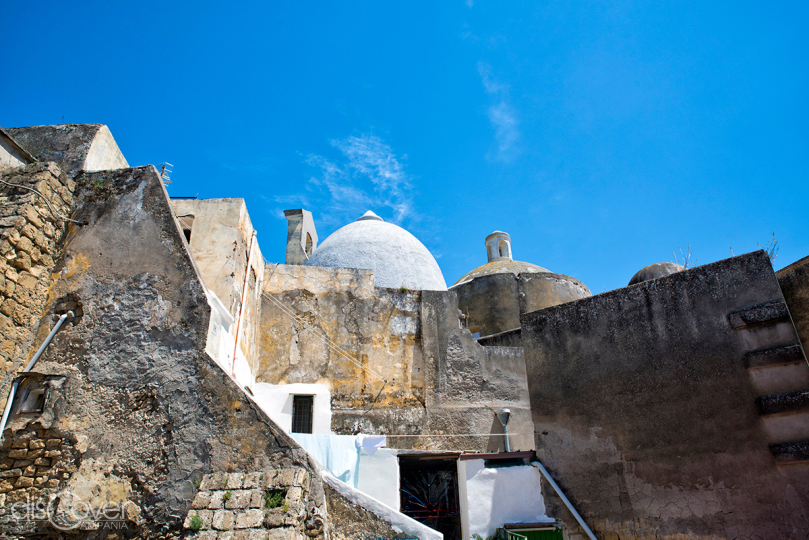


Charles III of Bourbon made it his favourite summer residence. In 1830 it became a prison and remained so until 1988.
From the top of the promontory that towers over the sea, it still seems to watch over the island. Just as it did when, then a modern fortress, it defended the village from the invasions of the Saracens, who had sown so much death and destruction in previous centuries. It had also happened after the D'Avalos, already lords of the City of Ischia, had obtained dominion over Procida from Charles V in 1529. It was a few decades later that Cardinal Innico D'Avalos decided to secure the village of Terra Casata, where the islanders took refuge when enemy sails appeared.
The narrow streets between the houses clinging to the promontory and the difficult access from Asino beach, to which the Procidans had hitherto entrusted their defence, were supplanted by an imposing wall, built around the new palace, overlooking the sea right in front of the village. And so, around 1560/70, Terra Casata became Terra Murata. The architects Cavagna and Tortelli were responsible for building the lordly residence, which changed the face of the place and revolutionised the urban layout of the entire island. To access the fortress, a new road was opened, today's Salita Castello. As part of that intervention, a large area, still known today as the Spianata, was cleared around the fortress for cultivated land. And it was as a result of that change that the settlement of Corricella was formed on the beach overlooked by the castle and that the convent of Santa Margherita Nuova was founded, while the ancient abbey of San Michele, in the heart of Terra Murata, took on the configuration it still retains today.
The sumptuous residence of the D'Avalos family remained in the family's possession until the 18th century, throughout the period of their control by King Charles of Bourbon, who chose it as his first royal hunting ground. Following this, Ferdinand IV also frequented it assiduously during the propitious season for hunting. In 1734, the palace became the Royal Palace, the first summer residence of the king who had just ascended the throne of Naples. Ten years later, it definitively became part of the Crown's patrimony due to the debts accumulated by Giambattista D'Avalos and became one of the twenty-two Royal Delights and one of the sovereign's favourite places.
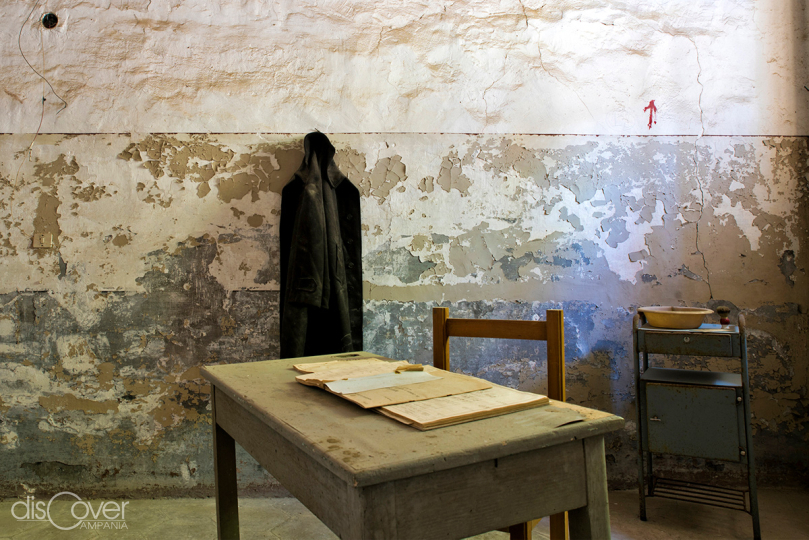
In 1815, a military school was established here, then, around 1830, it was converted into a prison, which also housed several political prisoners, such as Cesare Rosaroll and Luigi Settembrini. The conversion into a 'penal bath' transformed the historical structure in line with its new function, which it retained until 1988. It was only after a long period of neglect that in 2013 the palace became the property of the Procida Municipality, which began to carry out some restoration work and open it to the public.
The monumental complex, overturned by its long use as a prison, has kept its strong imprint intact, almost erasing all traces of the pre-existing building, apart from the façade, in Renaissance style with characteristic piperno finishes, such as the painted ceilings of the large rooms, subdivided to house the prisoners' cells. The guards' barracks is a 19th-century extension like other rooms in the prison that are more mobile. There was a building of individual cells, each painted a different colour by the inmates, and a building of group cells, some with as many as forty guests, and then the medicine room, the warden's house. And the teleria, where the hemp cloths were woven and linens were made, the carpentry and the bookbinding shop. All created by the Jesuits to rehabilitate prisoners. While the Esplanade, with its approximately two hectares of land, was used for crops and livestock, with produce sold weekly at a market set up in the prison. Most of the rooms included in the guided tours still look as if they have just been left by the inmates, with their uniforms, shoes, everyday objects. The last room offers an installation by Alfredo Pirri, entitled 7.0, because it was inaugurated in the morning at seven o'clock, as the work was conceived to intercept the first ray of sunlight of the new day.
PALAZZO D'AVALOS USEFUL INFO:
Opening hours:
Monday 10:30-13:00
Tuesday 10:30-13:00
Wednesday 10:30-13:00
Thursday 10:30-13:00
Friday 10:30-13:00
Saturday 10:30-13:00
Sunday 10:30-13:00
PRICE 13 EURO